|
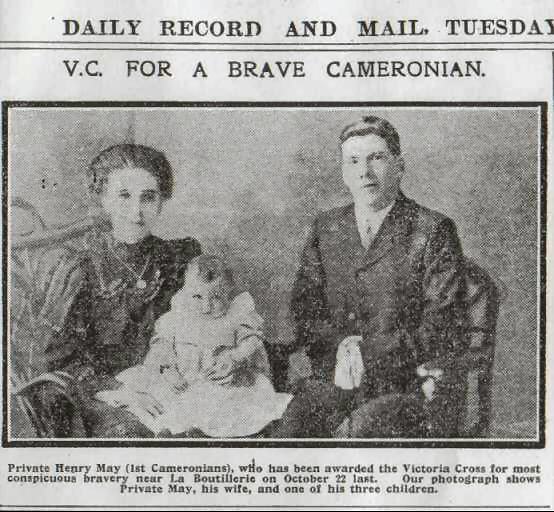
Extract and Photograph above from 'Daily
Record and Mail,' April 20th 1915:
GLASGOW'S VC.....A VISIT TO PRIVATE MAY'S HOME
One of the 'Daily Record and Mail' representatives had
the pleasing duty of conveying the glad tidings to Mrs.May.
Naturally she was delighted that the coveted distinction had been
awarded to her husband, but one thing she would have preferred even
before the Victoria Cross, as she frankly phrased it, " would be him
comin' in that door as weel as when he left."
Many woman with husbands at the war will appreciate the sentiment thus
expressed. Private May has his home at 38 Colvend Street, Bridgeton,
Glasgow, a quiet thoroughfare in the neighbourhood of Main Street and
adjacent to the bridge which connects with the Rutherglen side of the
river. He has a family of three, the eldest being a sunny little lady
of six summers, and the youngest, of the same sex, eighteen
months.
The hero is 29 years of age, and is known in several of the factories
in the East-end. Previous to joining the army, he acted as a mechanic
at the weaving mill of Messrs John Brown and Company, Adelphi Street,
and after serving the necessary three years with the colours he was
employed as a tenter in the weaving factory of Messrs Frew, Main
Street, Bridgeton.
When war broke out Private May had only about a fortnight of his time
to serve as a reservist. Called up with his comrades, he proceeded
immediately to the front, and in the interval he has participated in
nearly all the heavy fighting.
A LUCKY MAN
According to Mrs May, whose anxiety throughout the interview was
to tell her simple tale with befitting modesty, Private May "has always
been lucky." His fortune has been out on occasion, however, for
the gallant soldier received one wound. The mishap occurred on November
2. Happily the injury was not of a very serious nature, but it was
severe enough to necessitate his remaining in hospital for three weeks.
A piece of shrapnel, which had struck him on the cheek, was the cause
of his absence from duty.
Following upon the treatment at the hospital, Private May was was
transferred to the base, where he was detained for six weeks
Home leave was granted at the expiry of his stay at the base, and the
wounded hero reached Glasgow in time to enjoy the Christmas and New
Year festivities. His holiday among friends was a short one. Three
weeks saw it ended, and at the close of that period he was once again
on his way to the trenches.
Little that was detailed could be ascertained with respect to the
gallant action which had earned the Victoria Cross. In his speech and
in his letters from the front on his return to the fighting zone,
Private May had very little to say concerning the part he had
played.
Whispers had reached the ears of Private May that his bravery might be
rewarded with the Distinguished Conduct Medal, but an honour such as
had been awarded was never anticipated.
THE RESCUED OFFICER
Mrs May knew nothing of the earlier act mentioned in the official
version. To the best of her knowledge, Lieutenant D.A.H.Graham, an
Edinburgh gentleman, was the officer whom her husband had rescued.
Apologising for her lack of particulars, and for possible inaccuracies,
she explained that so far as she knew the officer was lying wounded
when Private May and a number of other men endeavoured to bring him
back to the British lines. In the attempt the others who had made the
gallant essay were wounded.
Private May, who, in the darkness, was unable to make out the
Cameronians lines. In the circumstances he did the next best thing
possible; he conveyed the wounded officer, although Lieutenant Graham
begged the the brave soldier to leave him to his fate, to a ditch,
where shelter was obtained.
To his chagrin, Private May found, with the arrival of daylight, that
the same amount of exertion would have suffice to bring the wounded
officer right among his friends, for the British lines were but a few
yards distant. Lieutenant Graham, it transpired, was wounded in
three places, and is believed to be recuperating in the East of
Scotland at the moment.
The noble part played by Private May did not escape notice, if
the announcement of the distinction does appear belated. In a letter
forwarded to his wife, Private May enclosed the following intimation
which had reached him:-
"Your Commanding
officer and brigade commander have informed me that you distinguished
yourself on 22nd October, 1914, near La Boutillerie. I have
read their report with much pleasure."
signed J.S.Keir, Major
General, Commanding 6th Division,
British Army in the Field, 31st March, 1915
|


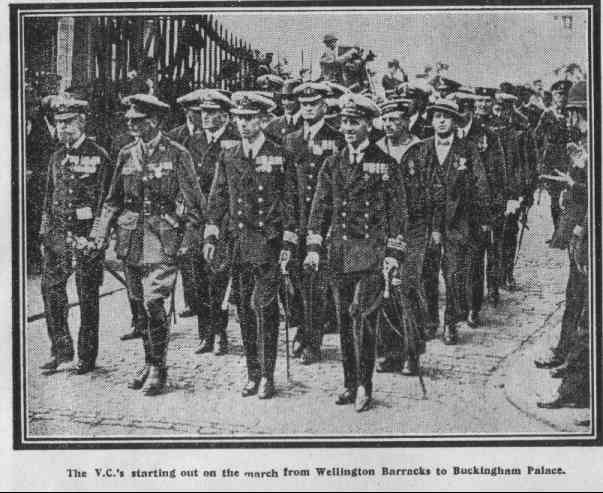
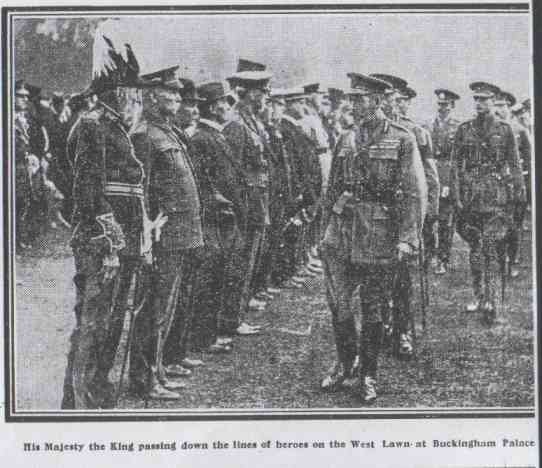
 Never in the nation's history has such a
spectacle been presented as was witnessed at Buckingham Place on
Saturday afternoon, when 324 heroes, all decorated with the Victoria
Cross - soldiers and sailors who had won the award for valour
during Britain's many wars of 61 years - were entertained by
their King at a garden party at the Palace.
Never in the nation's history has such a
spectacle been presented as was witnessed at Buckingham Place on
Saturday afternoon, when 324 heroes, all decorated with the Victoria
Cross - soldiers and sailors who had won the award for valour
during Britain's many wars of 61 years - were entertained by
their King at a garden party at the Palace.